On Sunday, 7 June at 2:30 PM, to celebrate Chaplin’s World’s 10th anniversary and Charlie Chaplin’s 137th birthday, fans will attempt to break the world record for the largest gathering of people dressed as Chaplin’s iconic Tramp character !
Chaplin’s World aims to surpass the previous record of 662 Tramps—so dig out a white shirt, black jacket, black trousers, and black shoes (the more ill-fitting and worn, the better!), and help make history!
Don’t forget to follow the museum’s tips to help you prepare!
Sunday, June 7 2026 - 2:30 PM
Chaplin’s World
Route de Fenil 2
1804 Corsier-sur-Vevey
Switzerland
BERLIN - From February 14 to 21, don’t miss this four of a kind series of live-to-Chaplin-film concerts at BABYLON, where the Babylon Orchester Berlin will perform the scores from The Circus, Modern Times, The Gold Rush (4K restored version), and City Lights!
Choreographed by internationally acclaimed choreographer and Principal Character Artist of The Royal Ballet, Alastair Marriott, this production brings Chaplin’s timeless magic to the stage of the New National Theatre Tokyo (新国立劇場 - Shin Kokuritsu Gekijō).
The score has been meticulously adapted for live orchestral performance by Chaplin music expert Timothy Brock.
Schedule:
Fri, 23 October 2026, 19:00
Sat, 24 October 2026, 13:00
Sat, 24 October 2026, 18:00
Sun, 25 October 2026, 14:00
Wed, 28 October 2026, 13:00
Sat, 31 October 2026, 13:00
Sat, 31 October 2026, 18:00
Sun, 1 November 2026, 14:00
In 1952, at the height of McCarthyism, Charlie Chaplin’s U.S. visa was rescinded. He found refuge with his family in Switzerland, at the Manoir de Ban, where he would spend the final 25 years of his life.
This Sunday, 18 January, the European cultural channel ARTE premieres a new documentary in its Houses of Art series, produced by Zentralfilm and directed by Sascha Schmidt, dedicated to Charlie Chaplin and the Manoir de Ban.
The Chaplin Office contributed archival materials to the film, which also features interviews with Eugene Chaplin, Arnold Lozano (Chaplin Office), Olivia Baliguet (Chaplin’s World), and others.
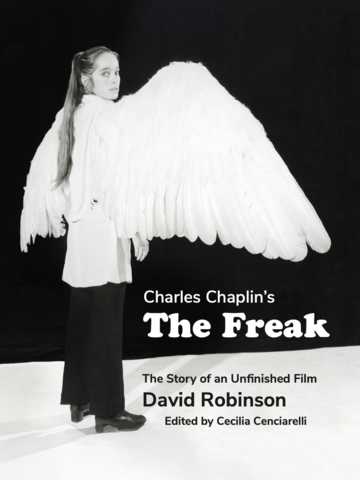
Originally released in Italian by Cineteca di Bologna in 2020, this edition presents Chaplin’s last, unfinished film for the first time to English-speaking readers—a project that has long intrigued Chaplin fans.
Chaplin conceived The Freak in 1968–69, close to his eightieth birthday, and produced the screenplay with remarkable speed. Even while seeking funding, he and producer Jerry Epstein commissioned designers, produced storyboards, and explored pre-CGI special effects, including the prototype wings for the leading actress—Chaplin’s daughter Victoria—which are now on display at Chaplin’s World in Switzerland.
Victoria recalls about her father:
“For hours, for weeks, for months, he studied the movements of birds in flight—the living mechanics of wings.
He watched films where men and women soared through the sky. But the techniques back then did not satisfy him. He wanted to find his own way—crafted, personal—a way to translate the sensation of flight onto the screen. I believe he would have found it.
But time clipped his wings. Charlie Chaplin never brought his vision to life.
The kites, the gulls, the crows of the canton of Vaud know something of this. Perhaps they kept, in some faint way, the memory of the man who once watched them with such loving eyes.”
Written by David Robinson and brought to fruition thanks in large part to Kate Guyonvarch, as well as through the longstanding commitment and expertise of our partner, Cineteca di Bologna, this book draws on a wealth of materials preserved in the Chaplin Archive.
It is not just the first-ever publication of an unknown Chaplin film script, but also highlights the Chaplin Office and Cineteca di Bologna’s crucial role in preserving and making accessible Chaplin’s archival treasures, with the support of the Chaplin family.
Watch for free: ARTE is streaming a documentary on the making of Chaplin’s Modern Times.
Chaplin’s Modern Times, The End of Silent Film is available until the end of November on Arte.tv with English subtitles, or on YouTube.
Directed by Grégory Munro and co-produced by Temps Noir and ARTE, it delves into the transition from silent to sound cinema, focusing on Modern Times. In 1936, nearly a decade after the advent of the talkies, Chaplin boldly defied the trend, releasing a film that embraced minimal speech, drawing instead on physical performance and inventive sound design.
Director: Grégory Monro|France|2024|55 min|Available until 29/11/2025
Photographer Lorenzo Burlando captured the atmosphere at Piazza Maggiore during the 100th anniversary screening of The Gold Rush, presented by Roy Export SAS (the Chaplin Office) and mk2 Films, in a new 4K restoration by the Cineteca di Bologna and L’Immagine Ritrovata showcased at Il Cinema Ritrovato 2025. See more photos on Facebook.
The screening took place on 26 June 2025—the exact date of the film’s original premiere 100 years ago. Thousands gathered in the square as Chaplin’s timeless classic returned to the big screen, its appeal undiminished.
The live score, adapted, arranged and conducted by Timothy Brock, was brilliantly performed by the Orchestra of the Teatro Comunale di Bologna — a remarkable rendition of the score Chaplin composed for the 1942 reissue.
Gian Luca Farinelli, director of the Cineteca di Bologna, introduced the film, presenting a stereoscopic image of the Chilkoot Pass, one of Chaplin’s key inspirations for The Gold Rush.
Carmen Chaplin, her husband Ashim Bhalla, and their daughter Uma were in attendance, pictured alongside Arnold Lozano, director of the Chaplin Office.
Thanks to the BFI National Archive, Blackhawk Films and the Lobster Films Collection, Das Bundesarchiv, Filmoteca de Catalunya, George Eastman Museum, and MoMA for their contributions to the restoration.
Special thanks to Cineteca di Bologna and L’Immagine Ritrovata, and to mk2 for their continued collaboration. Viva il cinema, viva Charlot!